What Are They?
-
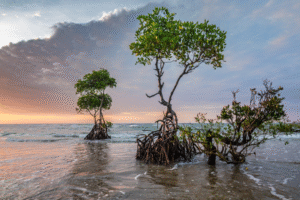
Mangrove trees are a type of tree species that grow in intertidal salty environments close to the mouths of river deltas along the coasts.
-
They can withstand frequent flooding.
-
They can absorb both fresh water from rivers and the nutrients needed from salt water.
Characteristics of Mangroves
-
These are plant species that can withstand salt.
-
They have roots that hang into the water.
-
They are salt tolerant and adapted to the extremely high salinity waters in which they grow.
-
They can release salt from their leaves to balance the amount of salt they consume.
-
They have produced aerial roots, also known as pneumatophore-bearing roots.
-
These forests have grown to withstand high temperatures quite well.
-
They reproduce viviparously.
Mangrove Distribution
In the World
-
They are typically found in warmer climates between latitudes 32 degrees north and 38 degrees south.
In India
-
They can be found in backwaters, salt marshes, tidal creeks, and protected estuaries along the entire Indian coastline.
-
The alluvial deltas of the Ganga, Godavari, Krishna, Cauvery, and the islands of Andaman and Nicobar are home to some of the world’s largest mangrove forests.
State/Union Territories |
Mangrove Areas |
West Bengal |
Sunderbans |
Orissa |
Bhitarkanika, Mahanadi, Subernarekha, Devi, Chilka, Dhamra, Mangrove Genetic Resources Centre |
Andhra Pradesh |
Coringa, East Godavari, Krishna |
Tamil Nadu |
Pichavaram, Muthupet, Ramnad, Pulicat, Kazhuveli |
Andaman and Nicobar |
North Andamans, Nicobar |
Kerala |
Vembanad, Kannur (Northern Kerala) |
Karnataka |
Coondapur, Dakshin Kannada/Honnavar, Karwar, Manglore Forest Division |
Goa |
Goa |
Maharashtra |
Achra-Ratnagiri, Devgarh-Vijay Durg, Veldur, Kundalika-Revdanda, Mumbra-Diva, Vikroli, Shreevardhan, Vaitarna, Vasai-Manori, Malvan |
Gujarat |
Gulf of Kutchh, Gulf of Khambhat, Dumas-Ubhrat |
The Importance of Mangroves
-
Rich Biodiversity and High Productivity
-
-
They have an extremely rich biodiversity and are a very productive ecosystem.
-
They serve as crucial breeding grounds for juvenile marine animals.
-
They offer refuge to a diverse range of marine species.
-
Numerous fish species, as well as:
-
Reptiles like land and sea turtles, alligators, crocodiles, caimans, snakes, and lizards
-
Invertebrates like prawns, crabs, oysters, tunicates, sponges, snails, and insects can be found there.
-
-
-
Shoreline Protection and Sediment Control
-
-
Sediments that flow off the land and down rivers are caught and held in place by their extensive root systems.
-
It stabilises the shoreline and stops storm and wave erosion.
-
It shields the coastal system from storm surges, cyclones, and other natural disasters.
-
They have become accustomed to tidal waves because they frequently encounter them.
-
Dangers to Mangroves
-
Overall Threat
-
-
Both man-made and natural factors pose a threat to them.
-
Over half of India’s mangrove forests have disappeared in the past four decades.
-
-
Natural Hazards
-
-
Natural disasters like cyclones and tsunamis have been wreaking havoc.
-
-
Dangers Associated with Human Activity
-
-
Clearing these forests for:
-
Industrial areas
-
Human settlements
-
Infrastructure (like harbours)
-
Agriculture
-
-
Both wood and fodder are in high demand from these trees.
-
The forests are declining as a result of overharvesting.
-
Dam construction causes:
-
Extremely high salinity in their habitat area, which the trees are unable to adjust to
-
River water blockage has dried up out of the vicinity
-
-
Pollution from industries and agricultural fields, such as:
-
Pesticides
-
Fertilisers
-
Other chemicals transported by river systems, may kill animals in these forests
-
Oil pollution can also choke the trees
-
-
Sea level stability is necessary for these forests to thrive
-
Climate change and global warming have caused sea level fluctuations
-
This upsets the delicate balance and endangers the ecosystem
-
-
The Way Ahead
-
Enforce stringent laws against deforestation
-
Encourage afforestation
-
Strengthen conservation laws in order to protect mangroves
-
Encourage eco-friendly travel
-
Improve community involvement
-
Repair damaged areas
-
Invest in:
-
Climate resilience plans
-
Scientific research
-
Sustainable livelihood options
-
-
The sustainability of mangrove ecosystems over the long term depends on:
-
International collaboration
-
Policy integration
-
In Conclusion
-
Mangroves are essential ecosystems that offer a variety of:
-
Ecological
-
Social
-
Economic
-
Ecological advantages
-
-
However, human activity and climate change pose a serious threat to them.
-
For their preservation and long-term use, it is essential to:
-
Comprehend their significance
-
Put into practice efficient conservation techniques.
-
विषय:- मैन्ग्रोव्स
मैन्ग्रोव्स
ये क्या हैं?
-
मैन्ग्रोव पेड़ एक प्रकार की वृक्ष प्रजाति हैं जो समुद्र तटों पर नदी डेल्टा के मुहानों के पास खारे पानी वाले ज्वारीय क्षेत्रों में उगते हैं।
-
ये बार-बार आने वाली बाढ़ को सहन कर सकते हैं।
-
ये नदियों से आने वाले ताजे पानी और समुद्री जल से आवश्यक पोषक तत्वों को सोख सकते हैं।
मैन्ग्रोव्स की विशेषताएं
-
ये पौधों की ऐसी प्रजातियाँ हैं जो नमक सहन कर सकती हैं।
-
इनके जड़ें पानी में लटकती हैं।
-
ये अत्यधिक खारे पानी में बढ़ने के लिए अनुकूलित और नमक सहनशील होती हैं।
-
ये अपने पत्तों से नमक बाहर निकाल सकती हैं ताकि ग्रहण किए गए नमक का संतुलन बना रहे।
-
इनके पास वायवीय जड़ें होती हैं, जिन्हें न्यूमैटोफोर युक्त जड़ें भी कहा जाता है।
-
ये वन उच्च तापमान को अच्छी तरह सहन करने के लिए विकसित हो चुके हैं।
-
ये विविपैरस रूप से प्रजनन करते हैं।
मैन्ग्रोव्स का वितरण
विश्व में
-
ये सामान्यतः 32° उत्तर अक्षांश और 38° दक्षिण अक्षांश के बीच के गर्म जलवायु वाले क्षेत्रों में पाए जाते हैं।
भारत में
-
ये संपूर्ण भारतीय समुद्री तटरेखा के साथ बैकवॉटर, खारे दलदल, ज्वारीय नाले और संरक्षित मुहानों में पाए जाते हैं।
-
गंगा, गोदावरी, कृष्णा, कावेरी के नदी डेल्टाओं और अंडमान व निकोबार द्वीप समूह में दुनिया के कुछ सबसे बड़े मैन्ग्रोव वन पाए जाते हैं।
राज्य/केंद्रशासित प्रदेश – मैन्ग्रोव क्षेत्र
-
पश्चिम बंगाल – सुंदरबन
-
ओडिशा – भितरकनिका, महानदी, सुबर्णरेखा, देवी, चिल्का, धामरा, मैन्ग्रोव जेनेटिक रिसोर्सेस सेंटर
-
आंध्र प्रदेश – कोरिंगा, ईस्ट गोदावरी, कृष्णा
-
तमिलनाडु – पिचावरम, मुथुपेट, रामनाड, पुलिकट, काझुवेली
-
अंडमान और निकोबार – उत्तर अंडमान, निकोबार
-
केरल – वेम्बनाड, कन्नूर (उत्तरी केरल)
-
कर्नाटक – कुंदापुर, दक्षिण कन्नड़/होन्नावर, कारवार, मंगलौर फॉरेस्ट डिवीजन
-
गोवा – गोवा
-
महाराष्ट्र – आचरा-रत्नागिरी, देवगढ़-विजयदुर्ग, वेलदूर, कुंडलिका-रेवदंडा, मुंब्रा-दीवा, विक्रोली, श्रीवर्धन, वैतरणा, वसई-मानोरी, मालवन
-
गुजरात – कच्छ की खाड़ी, खंभात की खाड़ी, डुमस-उभ्रत
मैन्ग्रोव्स का महत्व
समृद्ध जैव विविधता और उच्च उत्पादकता
-
ये अत्यधिक समृद्ध जैव विविधता रखते हैं और अत्यंत उत्पादक पारिस्थितिक तंत्र होते हैं।
-
ये समुद्री जीवों के बच्चों के लिए महत्वपूर्ण प्रजनन स्थल का काम करते हैं।
-
ये विभिन्न प्रकार की समुद्री प्रजातियों को शरण प्रदान करते हैं।
-
कई प्रकार की मछलियों के अलावा:
-
सरीसृप जैसे – जमीन और समुद्री कछुए, मगरमच्छ, घड़ियाल, कैमन, सांप और छिपकलियाँ
-
अकशेरुकी जीव जैसे – झींगे, केकड़े, सीप, ट्यूनिकेट्स, स्पंज, घोंघे और कीट
-
तट संरक्षण और तलछट नियंत्रण
-
ज़मीन से बहकर आने वाली तलछट को ये अपनी विस्तृत जड़ प्रणाली से रोककर रखते हैं।
-
ये तट को स्थिर बनाते हैं और तूफान व लहरों के कटाव से सुरक्षा प्रदान करते हैं।
-
ये तटीय तंत्र को समुद्री तूफानों, चक्रवातों और अन्य प्राकृतिक आपदाओं से बचाते हैं।
-
ये बार-बार ज्वारीय लहरों का सामना करने के कारण इनसे अनुकूल हो गए हैं।
मैन्ग्रोव्स को खतरे
कुल खतरा
-
इन्हें प्राकृतिक और मानवीय दोनों प्रकार के खतरे हैं।
-
भारत के आधे से अधिक मैन्ग्रोव वन पिछले चार दशकों में नष्ट हो चुके हैं।
प्राकृतिक खतरे
-
चक्रवातों और सुनामी जैसी प्राकृतिक आपदाओं ने भारी नुकसान पहुँचाया है।
मानव गतिविधियों से जुड़े खतरे
-
इन वनों की कटाई निम्नलिखित कार्यों के लिए हो रही है:
-
औद्योगिक क्षेत्र
-
मानव बस्तियाँ
-
आधारभूत ढांचे (जैसे बंदरगाह)
-
कृषि
-
-
इन पेड़ों से लकड़ी और चारे की अत्यधिक मांग है।
-
अत्यधिक कटाई के कारण वनों में गिरावट आ रही है।
-
बांधों के निर्माण से:
-
आवास क्षेत्र में अत्यधिक लवणता उत्पन्न हो जाती है, जिससे पेड़ अनुकूल नहीं हो पाते
-
नदी का जल प्रवाह रुकने से आस-पास का क्षेत्र सूख गया है
-
-
उद्योगों और कृषि क्षेत्रों से निकलने वाले प्रदूषक, जैसे:
-
कीटनाशक
-
उर्वरक
-
अन्य रासायनिक तत्व जो नदियों के माध्यम से पहुंचते हैं, इन वनों के जीवों को मार सकते हैं
-
तेल प्रदूषण से पेड़ों का दम घुट सकता है
-
-
इन वनों के पनपने के लिए समुद्र स्तर की स्थिरता जरूरी है
-
जलवायु परिवर्तन और वैश्विक तापमान वृद्धि ने समुद्र स्तर को अस्थिर किया है
-
इससे इनका नाजुक संतुलन बिगड़ जाता है और पारिस्थितिकी तंत्र खतरे में पड़ जाता है
-
आगे का रास्ता
-
वनों की कटाई के विरुद्ध सख्त कानूनों को लागू करना
-
पुनः वनीकरण को बढ़ावा देना
-
मैन्ग्रोव संरक्षण कानूनों को सुदृढ़ करना
-
पर्यावरण-अनुकूल पर्यटन को प्रोत्साहित करना
-
समुदाय की भागीदारी बढ़ाना
-
क्षतिग्रस्त क्षेत्रों की मरम्मत करना
-
निवेश करना:
-
जलवायु सहनशीलता योजनाओं में
-
वैज्ञानिक शोध में
-
टिकाऊ आजीविका विकल्पों में
-
-
मैन्ग्रोव पारिस्थितिकी तंत्र की दीर्घकालिक स्थिरता निर्भर करती है:
-
अंतरराष्ट्रीय सहयोग
-
नीति एकीकरण
-
निष्कर्ष
-
मैन्ग्रोव एक अत्यंत महत्वपूर्ण पारिस्थितिक तंत्र हैं जो कई प्रकार के लाभ प्रदान करते हैं:
-
पारिस्थितिक
-
सामाजिक
-
आर्थिक
-
पारिस्थितिक
-
-
हालांकि, मानवीय गतिविधियाँ और जलवायु परिवर्तन इन्हें गंभीर रूप से खतरे में डाल रहे हैं।
-
इनके संरक्षण और दीर्घकालिक उपयोग के लिए यह आवश्यक है कि:
-
इनके महत्व को समझा जाए
-
प्रभावी संरक्षण उपायों को लागू किया जाए |
-