Why in the News?
-
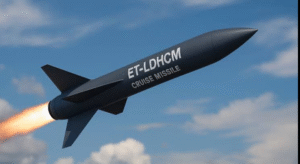
India has conducted tests of the ET-LDHCM, a new hypersonic missile.
-
India now has the ET-LDHCM, joining a small number of countries that have developed hypersonic weapon systems, such as China, Russia, and the United States.
Important Features:
-
Natively Produced: developed under the classified Project Vishnu initiative of the Defence Research and Development Organisation (DRDO) using only domestic technology.
-
Scramjet Engine: An advanced scramjet engine powers the missile. A scramjet, in contrast to conventional jet engines, uses atmospheric oxygen for combustion, enabling prolonged high speeds.
-
Hypersonic Speed: At its top speed of Mach 8, or roughly 11,000 km/h, or eight times the speed of sound, the missile can cover three kilometres in two seconds.
-
Range: roughly 1,500 kilometres.
-
Payload: It can use 1,000–2,000 kg conventional or nuclear warheads to target and destroy enemy locations.
-
Deep into enemy territory, including targets in China and Pakistan, it can deliver quick and devastating strikes.
-
As a result, the missile is being hailed as a possible shift in the military balance in Asia.
-
Low-altitude flying and manoeuvrability: The ET-LDHCM can manoeuvre in mid-flight and travels at low altitudes, in contrast to ballistic missiles that have predictable trajectories.
-
Durability and Stealth: It is composed of materials that are resistant to heat and can withstand temperatures of up to 2,000 degrees Celsius.
-
Its oxidation-resistant coatings guarantee that it will keep working even in the most harsh environments, such as seawater and strong sunlight.
-
Versatile Launch Platforms: It can be launched from the sea, the air, or the ground.
Vishnu Project:
-
India’s Defence Research and Development Organisation (DRDO) launched Project Vishnu, a program aimed at creating hypersonic cruise missiles.
-
With the help of fast, manoeuvrable weapons, the project seeks to transform India’s strike capabilities.