Why in News?
-
After Bandipur and Corbett, Assam’s Kaziranga Tiger Reserve (KTR) has the third-highest tiger density in India.
-
On Global Tiger Day 2025, the Assamese chief minister made the data public.
Concerning India’s Tiger Density:
-
Definition: The number of tigers per 100 square kilometres is known as tiger density.
-
It shows how well a region’s ecological balance and predator populations are doing.
Density-based Top 3 Tiger Reserves for 2024:
-
19.83 tigers per 100 square kilometres in Bandipur, Karnataka
-
19.56 tigers per 100 square kilometres in Corbett, Uttarakhand
-
Assam’s Kaziranga: 18.65 tigers per 100 square kilometres
The Tiger Count of Kaziranga:
-
There are 148 tigers in total (1,307.49 sq. km).
-
Up from 2022’s 104.
-
Consists of 27 tigers from the recently surveyed Biswanath Division.
Concerning Kaziranga National Park:
-
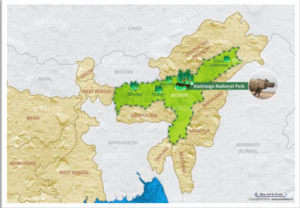
Where: Located in Golaghat and Assam’s Nagaon districts.
-
Lies along the Brahmaputra River’s floodplains.
Historical Significance:
-
Founded in 1905 at Mary Curzon’s suggestion.
-
In 1985, it was designated a UNESCO World Heritage Site.
-
In 2006, it became a Tiger Reserve.
Ecological Features:
-
Located in the biodiversity hotspot of the Eastern Himalayas.
-
Tropical forests, marshes, and tall elephant grass are among the habitats.
Flora:
-
There are four kinds of vegetation:
-
Alluvial grasslands
-
Woodlands in the savanna
-
Wet deciduous woods
-
Forests that are semi-evergreen
-
-
Trees of note: Cotton Tree, Indian Elephant Apple, Gooseberry
Fauna:
-
Home to more than 2,200 Indian one-horned rhinos, the largest population in the country.
-
Other species include Hoolock gibbons, swamp deer, elephants, and tigers.
-
Black-necked stork and greater adjutant are important migratory birds.
काजीरंगा राष्ट्रीय उद्यान:
क्यों चर्चा में है?
-
बंधीपुर और कॉर्बेट के बाद, असम का काजीरंगा टाइगर रिजर्व (KTR) भारत में तीसरा सबसे अधिक बाघ घनत्व वाला क्षेत्र है।
-
ग्लोबल टाइगर डे 2025 पर असम के मुख्यमंत्री ने यह आंकड़ा सार्वजनिक किया।
भारत में बाघ घनत्व के बारे में
-
परिभाषा: प्रति 100 वर्ग किलोमीटर में बाघों की संख्या को बाघ घनत्व कहा जाता है।
-
यह किसी क्षेत्र के पारिस्थितिक संतुलन और शिकारी जनसंख्या की स्थिति को दर्शाता है।
2024 के लिए घनत्व आधारित शीर्ष 3 टाइगर रिज़र्व
-
बंधीपुर, कर्नाटक: 19.83 बाघ प्रति 100 वर्ग किलोमीटर
-
कॉर्बेट, उत्तराखंड: 19.56 बाघ प्रति 100 वर्ग किलोमीटर
-
असम का काजीरंगा: 18.65 बाघ प्रति 100 वर्ग किलोमीटर
काजीरंगा का बाघ आंकड़ा
-
कुल 148 बाघ (1,307.49 वर्ग किलोमीटर क्षेत्रफल में)
-
2022 के 104 बाघों से वृद्धि
-
इसमें हाल ही में सर्वेक्षण किए गए बिस्वनाथ डिवीजन के 27 बाघ शामिल हैं
काजीरंगा राष्ट्रीय उद्यान के बारे में
-
स्थान: असम के गोलाघाट और नागांव जिलों में स्थित
-
ब्रह्मपुत्र नदी के बाढ़ मैदानों के साथ फैला हुआ
ऐतिहासिक महत्व
-
1905 में मैरी कर्ज़न के सुझाव पर स्थापित
-
1985 में यूनेस्को विश्व धरोहर स्थल घोषित
-
2006 में इसे टाइगर रिज़र्व घोषित किया गया
पारिस्थितिक विशेषताएँ
-
पूर्वी हिमालय की जैव विविधता हॉटस्पॉट में स्थित
-
उष्णकटिबंधीय वन, दलदल और ऊंची हाथी घास के मैदान यहाँ के प्रमुख पारिस्थितिक तंत्र हैं
वनस्पति
-
यहाँ चार प्रकार की वनस्पतियाँ पाई जाती हैं:
-
जलोढ़ घास के मैदान
-
सवाना वुडलैंड्स
-
आर्द्र पर्णपाती वन
-
अर्ध-सदाबहार वन
-
-
प्रमुख वृक्ष: रुई का पेड़, हाथी सेब का पेड़, आंवला
प्राणी जगत
-
2,200 से अधिक भारतीय एक सींग वाले गैंडे – देश में सबसे अधिक संख्या
-
अन्य प्रजातियाँ: हूलॉक गिबन, दलदली हिरण, हाथी और बाघ
-
प्रवासी पक्षियों में काली गर्दन वाला सारस और ग्रेटर एडजुटेंट प्रमुख