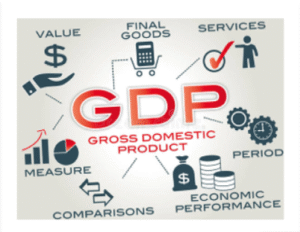
GDP: What is it?
-
GDP stands for Gross Domestic Product.
-
Gross Domestic Product is referred to as GDP.
-
It refers to the entire market value of all finished goods and services produced in a nation over a specific time period.
-
It is employed to evaluate an economy’s size and performance.
-
It facilitates the comparison of economic growth:
-
within the same nation, year after year
-
across international borders
-
GDP Types
-
GDP Nominal
-
-
Based on current market prices
-
Includes the impact of price fluctuations, such as inflation or deflation
-
-
Actual GDP
-
-
Computed using a base year’s constant prices
-
Reflects actual changes in production by accounting for inflation
-
The formula is as follows:
-
Real GDP growth rate = Nominal GDP growth rate – GDP Deflator inflation
-
-
-
GDP Deflator
-
-
Evaluates how much the price level has changed from the base year to the current one
-
Real GDP versus Nominal GDP shows the proportion of nominal GDP growth attributable to price increases as opposed to actual output
-
How is the GDP Determined?
-
There are three primary ways to measure GDP:
-
Income Method
-
-
-
-
Totals the earnings of all people and companies in the economy
-
-
-
Expenditure Method
-
-
-
Totals all expenditures for finished goods and services:
-
Investment
-
Consumption
-
Net exports
-
Government spending (exports minus imports)
-
-
-
-
Production (or Output) Method
-
-
-
Determines how much value is added overall at each production step
-
-
-
Both the income and expenditure methods are used to calculate GDP in India
-
The Ministry of Statistics and Program Implementation (MoSPI)’s National Statistical Office (NSO) disseminates the data
-
2011–12 is currently used as the base year for calculations
GDP Economic Significance
-
Health Indicator
-
-
A rising GDP denotes economic expansion
-
A falling GDP denotes economic contraction
-
-
Policy Formulation
-
-
Assists central banks and governments in creating monetary and fiscal policies
-
-
International Comparison
-
-
Used to rank and compare economies by international organisations such as the World Bank and IMF
-
-
Investment Decisions
-
-
To assess market potential and make investment decisions, investors consult GDP data
-
-
Trends in Employment
-
-
More jobs and higher income levels are frequently the results of growing GDP
-
-
Standard of Living
-
-
As real GDP rises over time, living standards rise as well
-
सकल घरेलू उत्पाद:
-
जीडीपी का अर्थ है सकल घरेलू उत्पाद
-
सकल घरेलू उत्पाद को जीडीपी कहा जाता है
-
यह किसी राष्ट्र में एक विशेष समय अवधि के दौरान उत्पादित सभी तैयार वस्तुओं और सेवाओं के पूरे बाजार मूल्य को दर्शाता है
-
इसका उपयोग अर्थव्यवस्था के आकार और प्रदर्शन का मूल्यांकन करने के लिए किया जाता है
-
यह आर्थिक वृद्धि की तुलना को आसान बनाता है:
-
एक ही देश के भीतर, वर्ष दर वर्ष
-
अंतर्राष्ट्रीय सीमाओं के पार
-
जीडीपी के प्रकार
-
नाममात्र जीडीपी (GDP Nominal)
-
-
वर्तमान बाजार मूल्यों पर आधारित
-
मूल्य में उतार-चढ़ाव के प्रभाव को शामिल करता है, जैसे कि मुद्रास्फीति या अपस्फीति
-
-
वास्तविक जीडीपी (Actual GDP)
-
-
किसी आधार वर्ष की स्थिर कीमतों का उपयोग करके गणना की जाती है
-
उत्पादन में वास्तविक परिवर्तनों को दर्शाती है क्योंकि यह मुद्रास्फीति को ध्यान में रखती है
-
सूत्र इस प्रकार है:
-
वास्तविक जीडीपी वृद्धि दर = नाममात्र जीडीपी वृद्धि दर – जीडीपी डिफ्लेटर मुद्रास्फीति
-
-
-
जीडीपी डिफ्लेटर (GDP Deflator)
-
-
मूल्य स्तर में आधार वर्ष से वर्तमान वर्ष तक कितना परिवर्तन हुआ है, इसका मूल्यांकन करता है
-
वास्तविक जीडीपी बनाम नाममात्र जीडीपी यह दिखाता है कि नाममात्र जीडीपी वृद्धि में कितना भाग मूल्य वृद्धि के कारण है और कितना वास्तविक उत्पादन के कारण
-
जीडीपी कैसे निर्धारित की जाती है?
-
जीडीपी को मापने के तीन प्रमुख तरीके हैं:
-
आय विधि (Income Method)
-
-
-
-
अर्थव्यवस्था में सभी व्यक्तियों और कंपनियों की आय को जोड़ा जाता है
-
-
-
व्यय विधि (Expenditure Method)
-
-
-
तैयार वस्तुओं और सेवाओं पर किए गए सभी खर्चों को जोड़ा जाता है:
-
निवेश
-
खपत
-
शुद्ध निर्यात
-
सरकारी खर्च (निर्यात माइनस आयात)
-
-
-
-
उत्पादन (या उत्पादन मूल्य) विधि (Production or Output Method)
-
-
-
उत्पादन की प्रत्येक चरण में जोड़े गए कुल मूल्य को निर्धारित करती है
-
-
-
भारत में जीडीपी की गणना के लिए आय और व्यय दोनों विधियों का उपयोग किया जाता है
-
सांख्यिकी और कार्यक्रम कार्यान्वयन मंत्रालय (MoSPI) का राष्ट्रीय सांख्यिकी कार्यालय (NSO) यह आंकड़े जारी करता है
-
वर्तमान में 2011–12 को आधार वर्ष के रूप में उपयोग किया जा रहा है
जीडीपी का आर्थिक महत्व
-
स्वास्थ्य संकेतक (Health Indicator)
-
-
बढ़ती जीडीपी आर्थिक विस्तार को दर्शाती है
-
गिरती जीडीपी आर्थिक संकुचन को दर्शाती है
-
-
नीति निर्माण (Policy Formulation)
-
-
मौद्रिक और राजकोषीय नीतियों को बनाने में केंद्रीय बैंकों और सरकारों की मदद करता है
-
-
अंतर्राष्ट्रीय तुलना (International Comparison)
-
-
विश्व बैंक और IMF जैसी अंतर्राष्ट्रीय संस्थाओं द्वारा अर्थव्यवस्थाओं की रैंकिंग और तुलना के लिए उपयोग किया जाता है
-
-
निवेश निर्णय (Investment Decisions)
-
-
बाजार की क्षमता का आकलन करने और निवेश निर्णय लेने के लिए निवेशक जीडीपी आंकड़ों को देखते हैं
-
-
रोजगार में रुझान (Trends in Employment)
-
-
बढ़ती जीडीपी अक्सर अधिक नौकरियों और उच्च आय स्तरों का परिणाम होती है
-
-
जीवन स्तर (Standard of Living)
-
-
जैसे-जैसे वास्तविक जीडीपी समय के साथ बढ़ती है, जीवन स्तर में भी सुधार होता है |
-