Why in News?
-
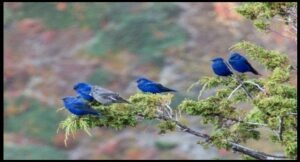
Recently, the Sainj Valley in Himachal Pradesh reported a rare sighting of the electric-blue bird Grandala, raising awareness of this elusive Himalayan species.
Concerning Grandala:
-
Grandala coelicolor is a member of the Turdidae (Thrush) family.
-
Grandala is a monotypic genus, meaning it contains only one species.
-
Arboreal insectivores eat insects that grow in trees.
Geographic Range of Distribution and Habitat:
-
Found throughout the northeastern Indian subcontinent and neighbouring areas, such as Tibet, India, Nepal, Bhutan, Myanmar, and other parts of China.
-
Alpine and subalpine areas are the preferred habitat.
-
Range of altitude: 3,000–5,000 meters
Important Features:
-
Dimensions: Length: 20.5–23 cm
-
38–52 grammes in weight
-
Men Plumage: Eye-catching blue-gray body with black tail and wings
-
Women: Brownish feathers with white stripes make up the plumage. White wing feather tips and undersides, gray-blue rump
-
Behaviour: During the non-breeding season, they are known to form large flocks, which can consist of up to 200 individuals and provide a breathtaking sight
Conservation Status:
-
The International Union for Conservation of Nature’s (IUCN) Red List has listed conservation status as Least Concern.
-
Although there are currently no known threats, this species is crucial for high-altitude ecosystem monitoring due to its habitat specificity
Himachal Pradesh’s Sainj Valley:
-
In Himachal Pradesh’s Kullu district sits the tranquil and little-visited Sainj Valley.
-
It is located inside the UNESCO-designated Great Himalayan National Park.
-
The valley is renowned for its dense forests, alpine meadows, traditional Himachali villages, and abundant biodiversity.
-
It is a significant ecological zone because it provides habitat for a number of endangered plant and animal species.
-
The valley is a well-liked location for trekking and ecotourism.