Skip links

Cy-TB Skin Test

Cy-TB Skin Test

Cy-TB Skin Test | UPSC Compass

Why in News?
  • As part of the National TB Elimination Programme (NTEP), Kerala has implemented the Cy-TB skin test as a streamlined method for detecting latent tuberculosis infection (LTBI).
Concerning the Cy-TB Skin Test:
What is it?
• A novel intradermal skin test called Cy-TB was created to identify people who may have latent tuberculosis infection (LTBI).
• Cy-TB employs particular antigens (ESAT-6 and CFP-10) derived from Mycobacterium tuberculosis, in contrast to conventional tests such as the Mantoux test or IGRA blood test.
• Type: Skin test administered intradermally to identify latent tuberculosis infection.
• Developer: Launched under India’s NTEP with assistance from ICMR and state TB units.
• The goal is to identify dormant TB early on in order to stop the disease from becoming active.
• Adults (18+) are the target group, particularly those in contact or high-risk groups.
How Does Cy-TB Operate?
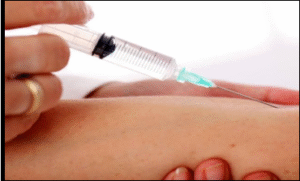
• A 0.1 ml solution with antigens unique to M. tuberculosis is injected into the inner forearm’s skin.
• Within 48 to 72 hours, a TB infection is indicated if there is an induration (raised swelling) of ≥5 mm.
• Cy-TB is less prone to cross-reaction, more specific, and doesn’t require blood samples, in contrast to Mantoux or IGRA.
• Reliable follow-up screening is made possible by the possibility of enhanced reactions in long-latent cases.
• The test aids in determining TB exposure but is unable to differentiate between latent infection and active disease.
Essential Elements of Cy-TB:
• High specificity reduces false positives from environmental mycobacteria or BCG by focussing on TB-specific antigens.
Extended shelf life: When refrigerated, multi-dose vials (10 doses) can be used for up to 28 days.
Basic logistics: Perfect for community-level or peripheral TB screening, it doesn’t require any lab equipment.
Quick deployment: On-site reading of the results is possible in 2–3 days; appropriate for large-scale screening.
Negative responses: Rare occurrences like ulceration are tracked under active safety review; most symptoms are mild (itching, swelling).