Understanding the Role of CSAT in UPSC Prelims
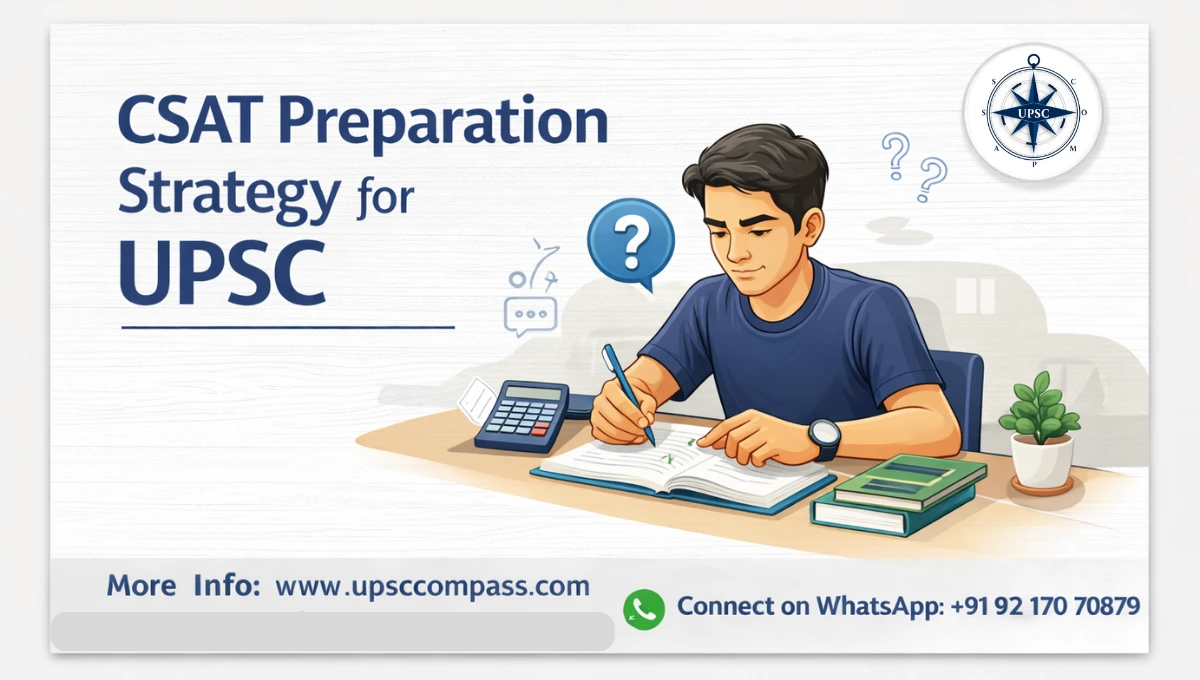
The Civil Services Aptitude Test (CSAT) is the second paper of the UPSC Preliminary Examination and has become a decisive factor for many aspirants. Although CSAT is qualifying in nature and requires 33% marks to pass, thousands of candidates fail to clear prelims every year because they underestimate this paper.
For a long time, aspirants focused almost entirely on the General Studies paper while ignoring CSAT preparation. However, the increasing difficulty level of comprehension passages, reasoning questions, and numerical aptitude has made CSAT a critical component of prelims preparation.
The key to clearing CSAT is not last-minute preparation. Instead, aspirants must develop regular practice habits, conceptual clarity, and time management skills.
A well-planned CSAT preparation strategy can turn this paper into one of the easiest parts of the prelims examination.
Why Many Aspirants Struggle with CSAT
Many aspirants preparing for UPSC come from diverse academic backgrounds. While candidates from engineering or mathematics streams may find CSAT easier, aspirants from humanities backgrounds often feel anxious about aptitude and numerical reasoning questions.
However, the real challenge of CSAT is not the difficulty of questions but the lack of consistent practice.
Aspirants often postpone CSAT preparation until the last few weeks before the exam. By that time, they realize that comprehension passages require speed and reasoning questions require logical clarity that cannot be developed overnight.
Another common mistake is ignoring previous year questions. UPSC tends to follow patterns in reasoning and comprehension questions. Without analyzing these patterns, aspirants miss valuable insights into the exam.
A structured preparation approach helps aspirants overcome these challenges effectively.
Building Conceptual Clarity in CSAT Topics
CSAT primarily tests four major areas:
-
Reading comprehension
-
Logical reasoning
-
Analytical ability
-
Basic numerical aptitude
Aspirants should start by strengthening their conceptual understanding of these topics rather than memorizing formulas or shortcuts.
Reading comprehension questions require careful reading and the ability to identify the central idea of a passage. Practicing comprehension regularly improves reading speed and analytical thinking.
Logical reasoning questions test an aspirant’s ability to evaluate arguments, identify patterns, and make logical conclusions. With consistent practice, these questions become significantly easier.
Numerical aptitude topics generally include basic arithmetic such as percentages, ratios, averages, and simple calculations. Aspirants do not need advanced mathematics knowledge but should develop comfort with basic calculations.
At UPSC Compass, CSAT preparation sessions focus on strengthening these fundamental concepts while helping aspirants build confidence in solving questions under time pressure.
Importance of Regular CSAT Practice
CSAT preparation requires consistent practice rather than occasional study sessions.
Aspirants should ideally dedicate a few hours every week to solving CSAT questions. This helps develop familiarity with different types of questions and improves accuracy.
Practicing previous year questions is one of the most effective ways to understand the UPSC pattern. It helps aspirants recognize recurring question types and develop strategies to solve them efficiently.
Another important aspect of CSAT preparation is improving reading speed. Many aspirants struggle with long comprehension passages during the exam because they are not used to reading lengthy texts quickly.
Regular reading and comprehension practice can significantly improve this skill over time.
Role of Mock Tests in CSAT Preparation
Mock tests play an essential role in CSAT preparation because they simulate real exam conditions. Attempting mock tests helps aspirants develop the ability to solve questions under time pressure.
However, simply attempting mock tests is not enough. Aspirants must carefully analyze their performance after each test. Understanding mistakes and identifying weak areas allows aspirants to improve steadily.
A structured CSAT test series provides aspirants with exam-level practice and detailed explanations, helping them refine their strategy.
At UPSC Compass, mock tests are designed to reflect the actual UPSC exam pattern. Aspirants receive performance analysis and guidance that helps them improve both accuracy and speed.
Managing Time During the CSAT Exam
Time management is one of the most important skills required for CSAT. Many aspirants waste too much time on difficult questions and fail to complete the paper.
A better strategy is to attempt easier questions first and return to complex questions later.
Developing this exam temperament requires consistent practice and exposure to mock tests.
When aspirants practice regularly, they become more comfortable with the exam pattern and can manage their time effectively.
Conclusion
CSAT should never be treated as a secondary paper in UPSC preparation. Although it is qualifying in nature, failing CSAT automatically disqualifies a candidate from the next stage of the examination.
Aspirants who prepare systematically by practicing comprehension, reasoning, and aptitude questions can easily clear the qualifying cutoff.
With structured guidance, regular practice, and proper strategy, CSAT can become one of the easiest papers to clear in the prelims examination.
Aspirants seeking structured preparation support can explore programs and test series at: Click Here
FAQs
Q1. Is CSAT difficult for humanities students?
CSAT may initially feel challenging for humanities students, but with regular practice and conceptual clarity it becomes manageable.
Q2. How many hours should be dedicated to CSAT preparation?
Aspirants can prepare effectively by dedicating 2–3 hours per week to CSAT practice along with mock tests.
Q3. Are previous year questions useful for CSAT?
Yes. Practicing previous year questions helps aspirants understand the pattern and difficulty level of the exam.
Q4. Can CSAT be cleared without coaching?
Yes. With proper practice and guidance, aspirants can clear CSAT through self-study and structured mock tests.