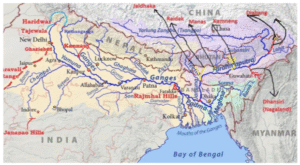
Important Aspects of the Brahmaputra River System
Meaning
-
“Son of Brahma” is the meaning of the name Brahmaputra.
Origin and Source
-
In southwest Tibet, the river rises from the Chemayungdung Glacier.
-
Its source is extremely close to where the Indus and Satluj rivers originate.
-
Mariam La divides Manasarovar Lake from the source of the Brahmaputra.
Tibet Course
-
It passes through the Indus-Tsangpo Structure Zone’s depression in Tibet, which is situated between:
-
The southern Great Himalayas
-
To the north, the Kailas Range
-
-
The river is slow despite its high elevation because of its gentle slope.
-
In Tibet, it has a broad, passable channel that stretches for about 640 kilometres.
-
Here, it receives a number of tributaries.
-
Raga Tsangpo is the first significant tributary, joining close to Lhatse Dzong.
-
Name and Cross-Regional Flow
-
Tsangpo, or “The Purifier,” is the name given to it in Tibet.
-
Known as Yarlung Zangbo Jiangin in China.
-
The Yarlung Tsangpo River flows across southern Tibet before bursting through the Himalayas.
-
Known as Dihang in Arunachal Pradesh.
-
Dihang turns southwest just west of the town of Sadiya, where it meets the Lohit River and the Dibang River.
-
The river is known as the Brahmaputra after they meet.
-
Continues as the Brahmaputra River in Assam.
-
Known as the Jamuna River in Bangladesh.
-
Creates the Padma River by joining the Ganga River.
-
Eventually forms the Sunderbans Delta after merging with the Meghna River.
River Islands
-
The world’s largest river island is Majuli Island in Assam.
-
The world’s smallest inhabited river island is Umananda Island in Assam.
Significant Cities and Towns
-
Dibrugarh
-
Pasighat
-
Neamati
-
Tezpur
-
Guwahati on the Brahmaputra
Principal Brahmaputra River Tributaries
Left Bank Tributaries
-
Dhansiri
-
Lohit
-
Dibang
Right Bank Tributaries
-
Subansiri
-
Kameng
-
Manas
-
Sankosh
ब्रह्मपुत्र नदी:
ब्रह्मपुत्र नदी प्रणाली के महत्वपूर्ण पहलू
अर्थ
-
“ब्रह्मा का पुत्र” ब्रह्मपुत्र नाम का अर्थ है।
उद्गम और स्रोत
-
यह नदी दक्षिण-पश्चिम तिब्बत में चेमायुंगडुंग ग्लेशियर से निकलती है।
-
इसका स्रोत सिंधु और सतलज नदियों के उद्गम स्थल के बहुत निकट स्थित है।
-
मारीअम ला ब्रह्मपुत्र के स्रोत को मानसरोवर झील से अलग करता है।
तिब्बत में प्रवाह
-
यह नदी तिब्बत में इंडस-त्सांगपो संरचना क्षेत्र के गर्त से होकर गुजरती है, जो स्थित है:
-
दक्षिण में ग्रेट हिमालय
-
उत्तर में कैलास पर्वतमाला
-
-
ऊँचाई अधिक होने के बावजूद नदी की ढाल कम होने के कारण इसका प्रवाह धीमा होता है।
-
तिब्बत में इसका चौड़ा और नौगम्य मार्ग लगभग 640 किलोमीटर तक फैला हुआ है।
-
यहां इसे कई सहायक नदियाँ प्राप्त होती हैं।
-
रागा त्सांगपो पहली प्रमुख सहायक नदी है, जो ल्हात्से डजोंग के पास मिलती है।
-
नाम और क्षेत्रों में प्रवाह
-
तिब्बत में इसे त्सांगपो, यानी “शुद्ध करने वाला” कहा जाता है।
-
चीन में इसे यारलुंग ज़ंगबो जियांगिन के नाम से जाना जाता है।
-
यारलुंग त्सांगपो नदी दक्षिणी तिब्बत से बहती हुई हिमालय को पार करती है।
-
अरुणाचल प्रदेश में इसे दिहांग कहा जाता है।
-
दिहांग सादिया नगर के पश्चिम में दक्षिण-पश्चिम दिशा की ओर मुड़ती है, जहाँ यह लोहित और दिबांग नदियों से मिलती है।
-
इनके संगम के बाद इस नदी को ब्रह्मपुत्र कहा जाता है।
-
यह असम में ब्रह्मपुत्र नदी के रूप में बहती रहती है।
-
बांग्लादेश में इसे जमुना नदी कहा जाता है।
-
यह गंगा नदी से मिलकर पद्मा नदी बनाती है।
-
अंततः यह मेघना नदी से मिलकर सुंदरबन डेल्टा बनाती है।
नदी द्वीप
-
असम में माजुली द्वीप विश्व का सबसे बड़ा नदी द्वीप है।
-
असम में ही उमनंदा द्वीप विश्व का सबसे छोटा आबाद नदी द्वीप है।
महत्वपूर्ण शहर और नगर
-
डिब्रूगढ़
-
पासीघाट
-
नेमाटी
-
तेजपुर
-
गुवाहाटी (ब्रह्मपुत्र पर स्थित)
मुख्य ब्रह्मपुत्र नदी की सहायक नदियाँ
बाएँ किनारे की सहायक नदियाँ
-
धांसीरी
-
लोहित
-
दिबांग
दाएँ किनारे की सहायक नदियाँ
-
सुबनसिरी
-
कामेंग
-
मानस
-
संकोश