Skip links

Congo Basin

Congo Basin

A new $15 million initiative has been launched to promote sustainable investment in the Congo Basin.
Basic Overview:
The Congo Basin is the second-largest river basin in the world after the Amazon.
It covers about 4 million sq km across Central Africa.
It is drained by the Congo River, the deepest river in the world (over 220 m deep).
Location and Countries:
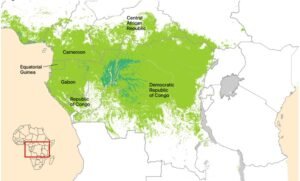
Lies in Central Africa, covering six countries.
Countries include Democratic Republic of the Congo, Republic of Congo, Cameroon, Gabon, Equatorial Guinea, and Central African Republic.
The Congo River flows into the Atlantic Ocean after forming a vast arc.
Physical Geography:
Composed of tropical rainforests, swamps, wetlands, and rivers.
Has an equatorial climate with high rainfall throughout the year.
Rainfall ranges up to 2,000 mm annually in central areas.
Biodiversity and Ecology:
Second-largest tropical rainforest, rich in biodiversity.
Home to over 10,000 plant species and 400 mammal species.
Hosts endangered species like gorillas and forest elephants.
Human Geography:
Inhabited by more than 150 ethnic groups including Indigenous tribes.
Main activities include shifting agriculture and subsistence farming.
Communities also rely on hunting and fishing for livelihood.
Environmental Importance:
Stores over 30 billion metric tons of carbon.
Vital global carbon sink for climate regulation.
Facing threats from illegal logging and mineral exploitation.
Conservation Initiatives:
Part of the Central African Forest Initiative (CAFI) for forest protection.
In 2024, a $15 million initiative launched to support nature-positive businesses.
Backed by UNEP and UNCDF, focused on green entrepreneurship.
कांगो बेसिन
कांगो बेसिन में सतत निवेश को बढ़ावा देने के लिए 15 मिलियन डॉलर की नई पहल शुरू की गई है।
मूल परिचय:
कांगो बेसिन विश्व का दूसरा सबसे बड़ा नदी बेसिन है, अमेज़न के बाद।
इसका क्षेत्रफल लगभग 4 मिलियन वर्ग किलोमीटर है, जो मध्य अफ्रीका में फैला है।
इसे कांगो नदी से जलमग्न किया जाता है, जो विश्व की सबसे गहरी नदी है (220 मीटर से अधिक गहरी)।
स्थान और देश:
यह मध्य अफ्रीका में स्थित है और छह देशों में फैला हुआ है।
इनमें शामिल हैं: डेमोक्रेटिक रिपब्लिक ऑफ कांगो, रिपब्लिक ऑफ कांगो, कैमरून, गैबॉन, इक्वेटोरियल गिनी, और सेंट्रल अफ्रीकन रिपब्लिक।
कांगो नदी एक विशाल घुमाव बनाकर अटलांटिक महासागर में गिरती है।
भौगोलिक विशेषताएँ:
यह क्षेत्र उष्णकटिबंधीय वर्षावनों, दलदली क्षेत्रों और नदियों से बना है।
यहाँ का मौसम समशीतोष्णीय (इक्वेटोरियल) है, जहाँ पूरे साल भारी वर्षा होती है।
वर्षा का औसत लगभग 2,000 मिमी प्रति वर्ष होता है।
जैव विविधता और पारिस्थितिकी:
यह विश्व का दूसरा सबसे बड़ा उष्णकटिबंधीय वर्षावन है, जो जैव विविधता में समृद्ध है।
यहाँ 10,000 से अधिक पौधों की प्रजातियाँ और 400 से अधिक स्तनधारी जीव पाए जाते हैं।
इस क्षेत्र में संकटग्रस्त प्रजातियाँ जैसे गोरिल्ला और वन हाथी पाए जाते हैं।
मानव भूगोल:
यहाँ 150 से अधिक जातीय समूह निवास करते हैं, जिनमें कई आदिवासी समुदाय शामिल हैं।
मुख्य जीविका के साधन परिवर्ती कृषि और आजीविका आधारित खेती हैं।
लोग शिकार और मछली पकड़ने पर भी निर्भर करते हैं।
पर्यावरणीय महत्व:
यह क्षेत्र 30 अरब से अधिक मीट्रिक टन कार्बन संग्रहित करता है।
यह एक महत्वपूर्ण वैश्विक कार्बन सिंक है, जो जलवायु नियंत्रण में सहायक है।
यहाँ अवैध कटाई और खनिज उत्खनन जैसी समस्याएं बढ़ रही हैं।
संरक्षण पहल:
यह क्षेत्र सेंट्रल अफ्रीकन फॉरेस्ट इनिशिएटिव (CAFI) के तहत संरक्षण में है।
2024 में $15 मिलियन की नई योजना शुरू की गई है जो प्रकृति-हितैषी उद्यमों का समर्थन करती है।
इसे संयुक्त राष्ट्र पर्यावरण कार्यक्रम (UNEP) और संयुक्त राष्ट्र पूंजी विकास कोष (UNCDF) द्वारा समर्थित किया गया है।